Zero passwords.
Zero compromise.
BlackWall is a production-grade authorisation server where passwords simply don't exist. Hardware keys, passkeys and platform authenticators, combined with fully standards-compliant OAuth 2.1 and OpenID Connect, give your applications authentication infrastructure that cannot be phished, breached or guessed.
One console for identity,
entitlement and evidence
Most companies buy an identity provider, a licensing system and an audit tool, then spend a year making them agree with one another. BlackWall ships all three against a single tenancy model, so a user, the software they are entitled to, and the record of what they did are the same story told once.
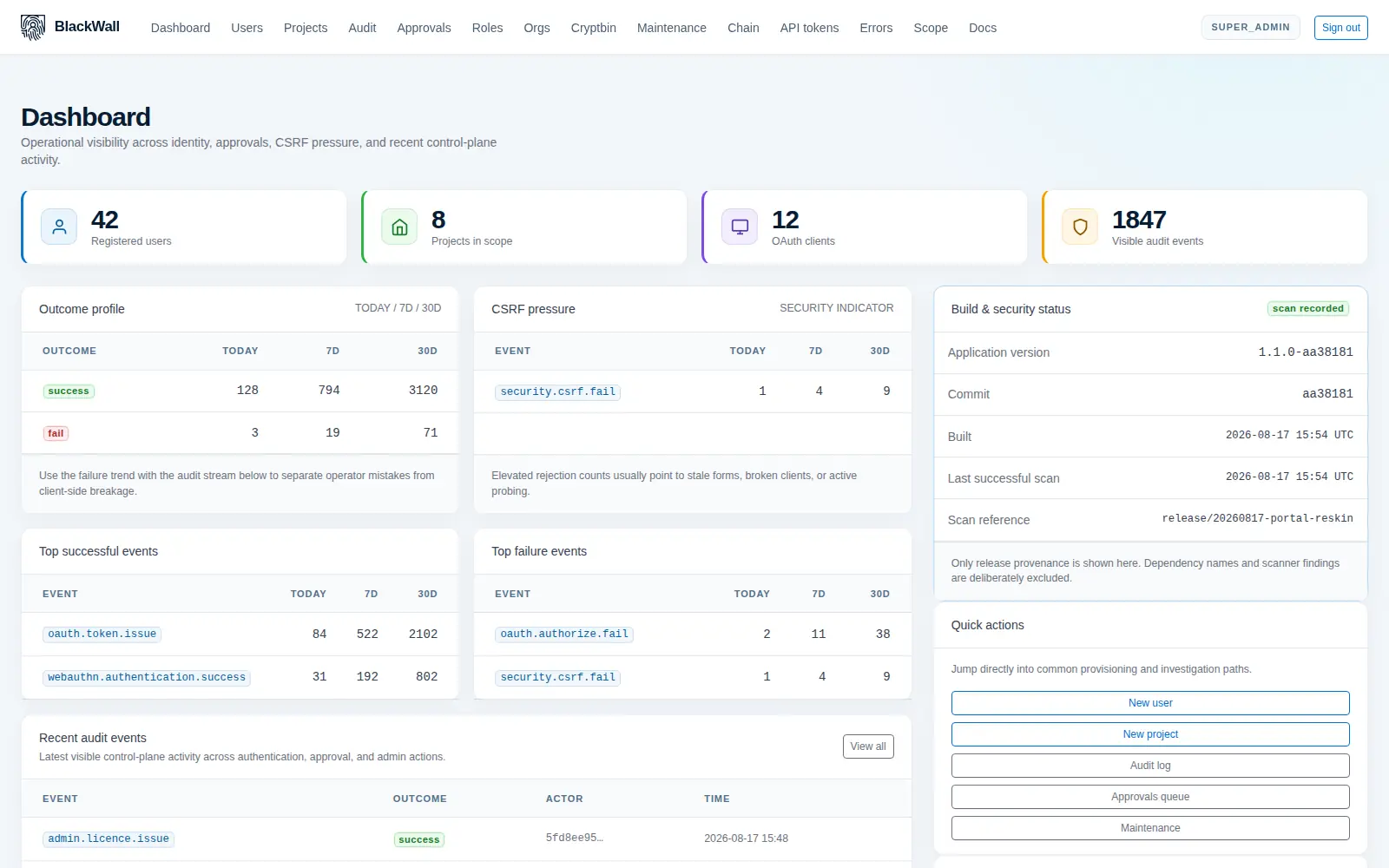
No password column, no reset flow, no credential-stuffing surface.
Named, ordered tiers that travel inside the token as claims.
OIDC, OAuth 2.1, SAML 2.0, SCIM 2.0 and signed webhooks.
Every mutation, flow and assertion, hash-chained row by row.
What BlackWall does
Seven capabilities, one tenancy model, one audit trail. Follow any of them for the detail.
Sell your software.
Prove the entitlement.
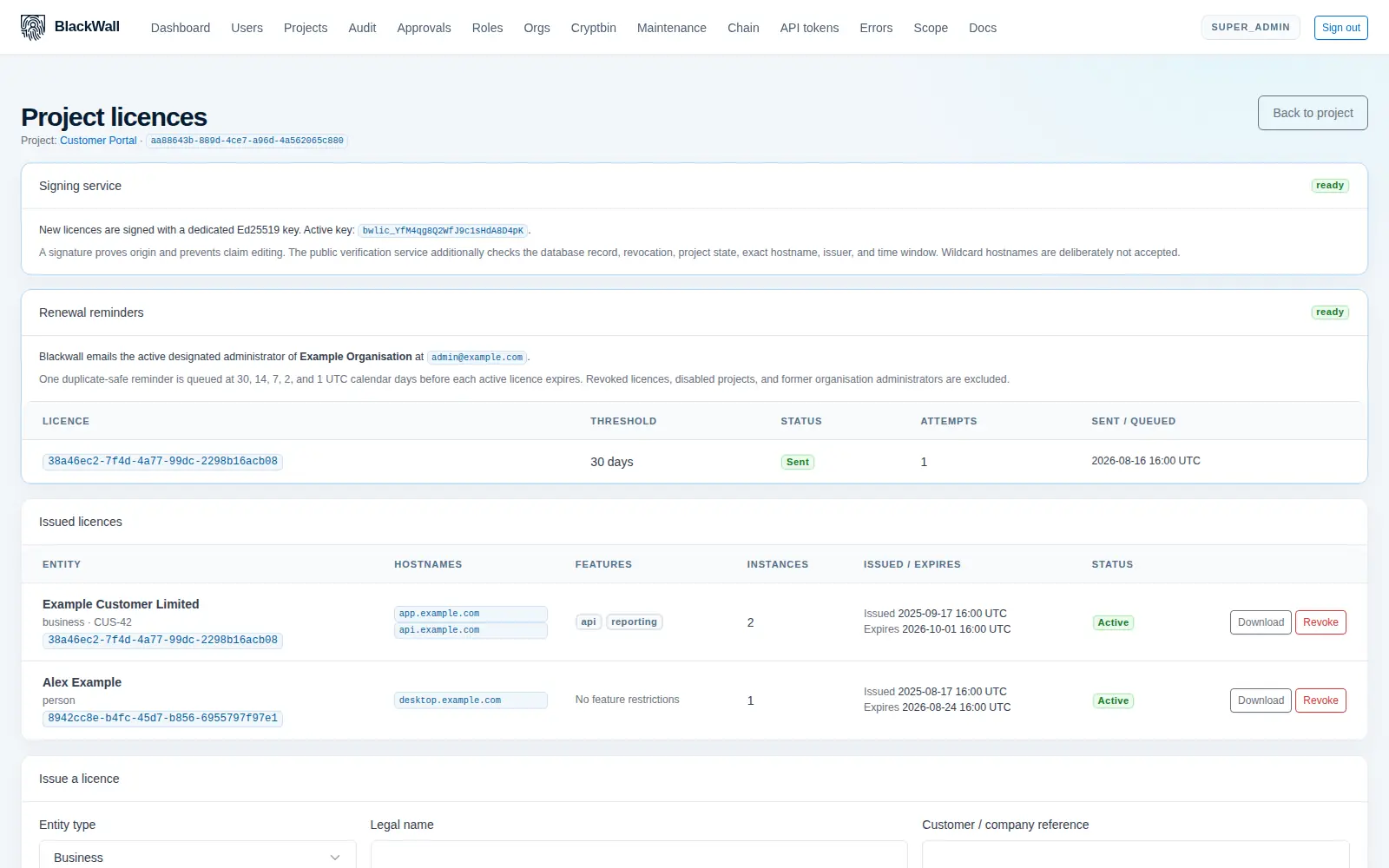
Licensing is usually a spreadsheet, a shared secret and an argument at renewal time. BlackWall turns an entitlement into a cryptographic object: signed with Ed25519, bound to exact hostnames, scoped to named features, and revocable the moment a contract ends.
- Bound to reality — up to 32 exact hostnames or IP literals. Wildcards are rejected, not tolerated.
- Tamper-proof — edit any claim and the signature fails. There is nothing to negotiate.
- Revocable — an authoritative verifier answers in real time, so cancellation takes effect immediately.
- Renewal aware — reminders are queued at 30, 14, 7, 2 and 1 days before expiry.
Evidence you can
hand to an auditor
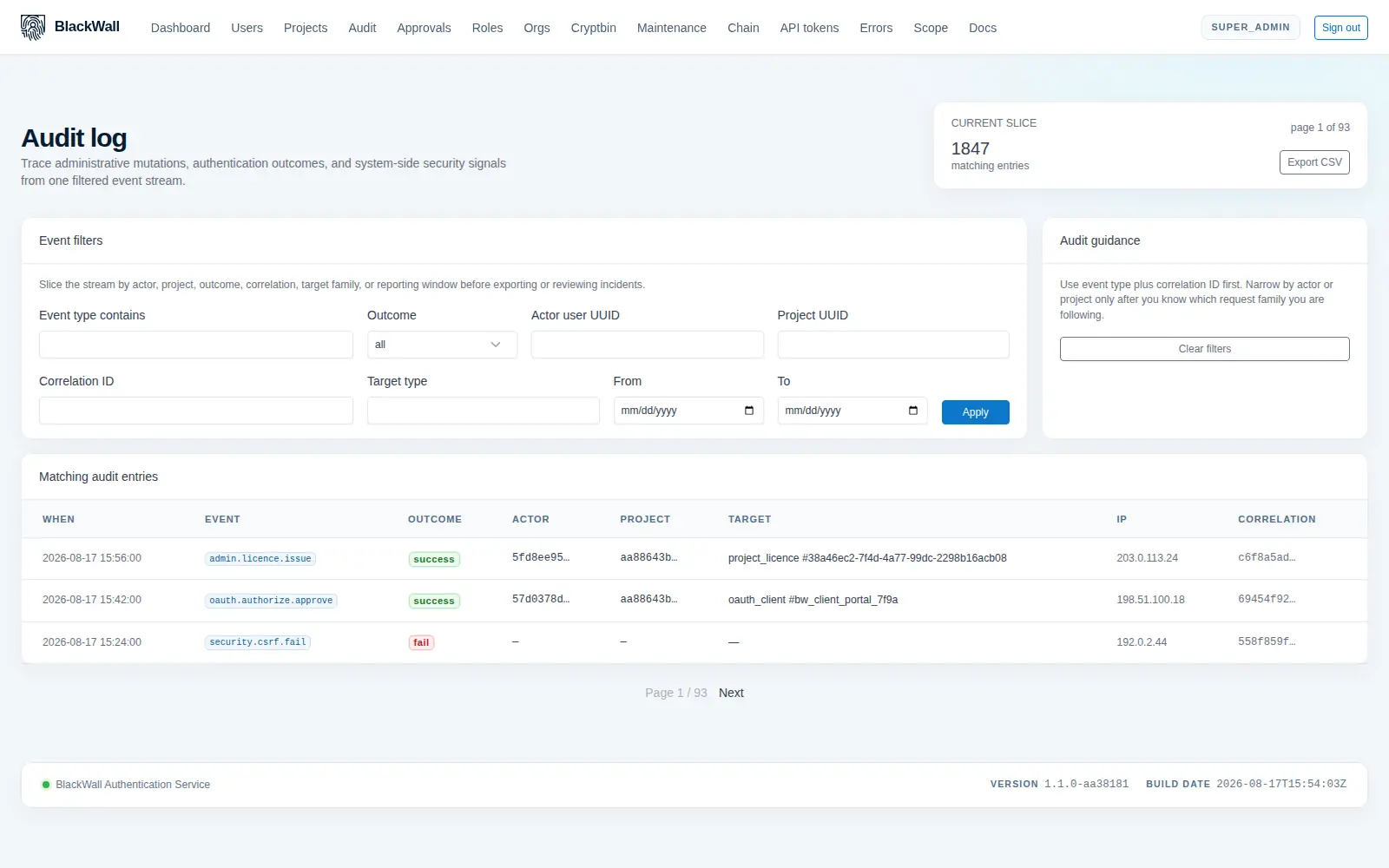
An audit log that anyone with database access can quietly edit is not evidence — it is a formality. BlackWall chains every row into the one before it, so altering a single historical entry invalidates every entry that follows and the tampering announces itself.
- Hash-chained rows — each entry commits to its predecessor under a serialising lock.
- Signed checkpoints — the tip of the log is signed and published, so truncation is detectable too.
- Correlation IDs — trace one end-user request across every service it touched.
- Full coverage — admin mutations, OAuth flows and WebAuthn assertions alike.
Share a secret.
Never the plaintext.
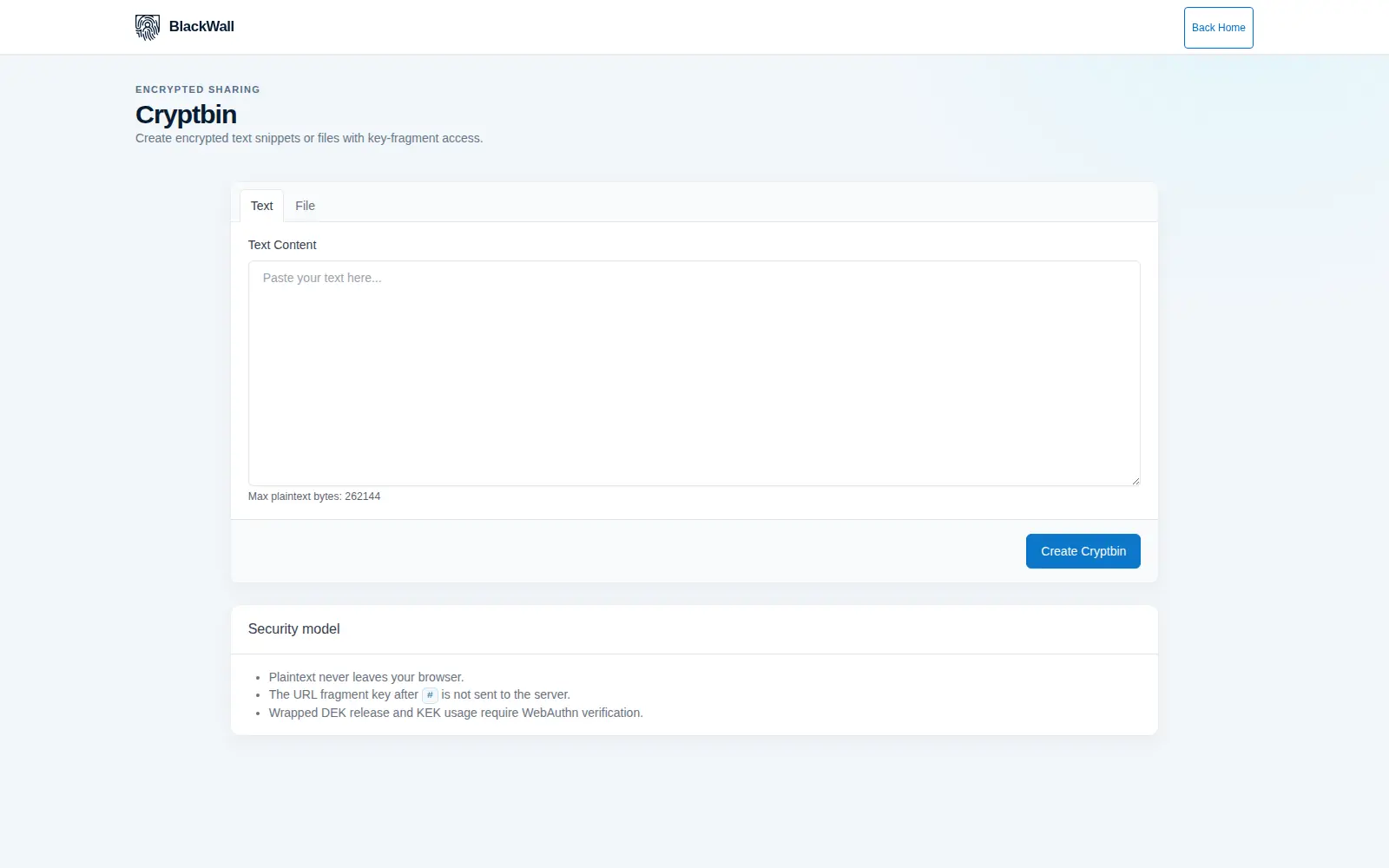
Cryptbin is end-to-end encrypted sharing built directly into the platform. Your browser generates the key and keeps it in the URL fragment — the part browsers never send to a server. BlackWall stores ciphertext it cannot read.
Built for teams who have to
prove it, not just say it
Software vendors
Authenticate customers and license the product they bought from the same platform, with revocation that actually takes effect.
Regulated businesses
Tamper-evident audit, approval workflows and release provenance — the evidence an assessor asks for, produced as a by-product of normal use.
Platform teams
One identity surface for many products, isolated per project, with privilege levels that arrive inside the token instead of a bespoke lookup.
Security-first startups
Start with no passwords at all. There is no migration to phishing-resistant auth later, because there was never anything to migrate.