
Share the secret, not the plaintext
Sensitive material gets pasted into chat every day because the secure option is too much effort. Cryptbin makes the secure option the easy one: your browser encrypts before anything is uploaded, and BlackWall stores ciphertext it has no way to read.
The key never reaches the server
The encryption key lives in the URL fragment — everything after the #. Browsers
never transmit that portion of a URL in an HTTP request, so the key travels with your
recipient and never with the ciphertext.
- AES-256-GCM in the browser — the payload is encrypted locally before upload.
- Ciphertext-only storage — the server holds the encrypted blob and public metadata.
- Wrapped at rest — the stored key copy is wrapped with XChaCha20-Poly1305 and bound to the item identifier.
- WebAuthn gated — creating, viewing, updating and deleting all require a live assertion.
- Automatic expiry — entries disappear on a schedule, per item or by system default.
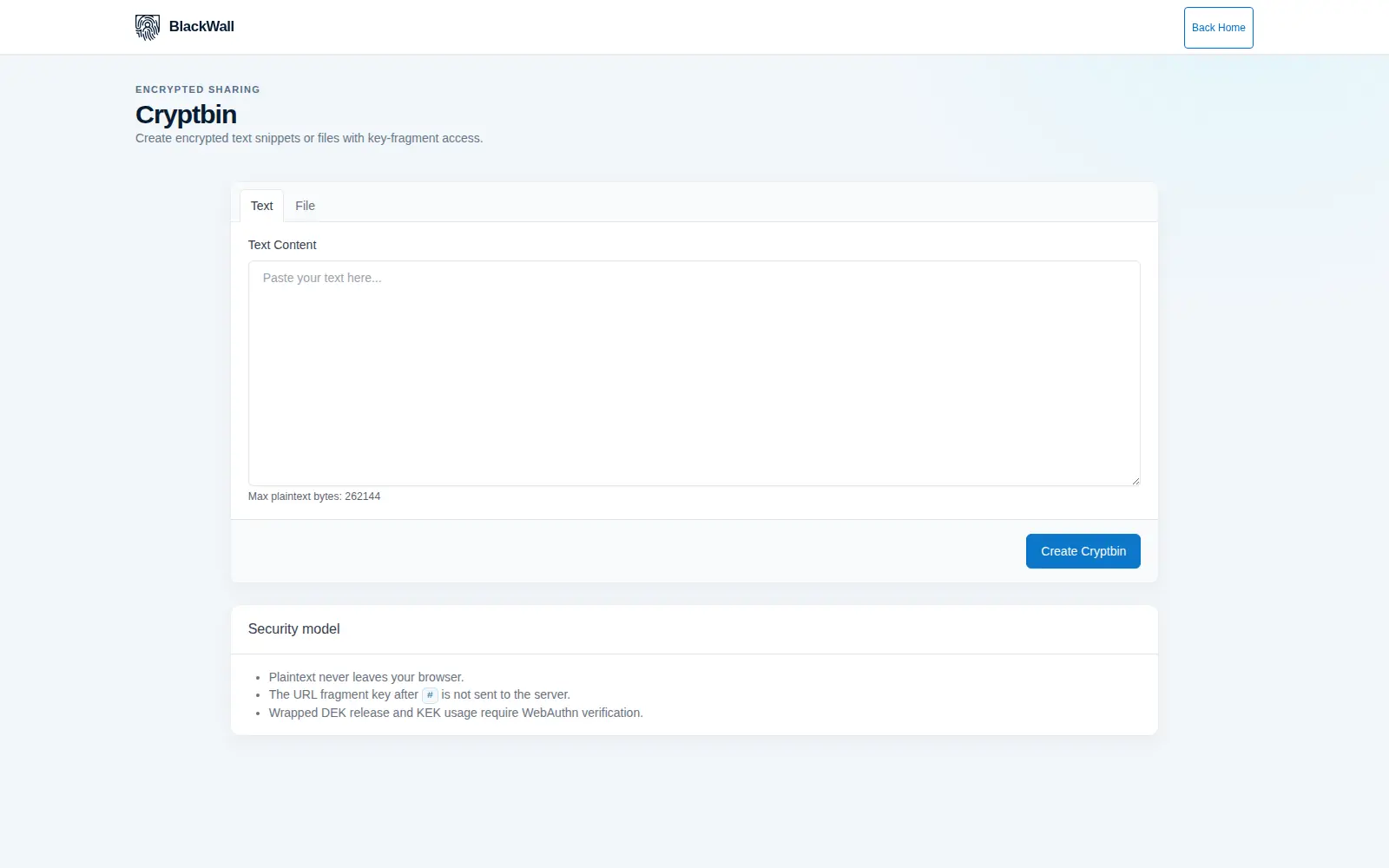
What actually happens
Four steps, none of which involve BlackWall learning your content.
-
Your browser generates a key
A data-encryption key is created client-side. It is never transmitted to the server at any point in the process.
-
The payload is encrypted locally
Your browser encrypts the text or file with AES-256-GCM and uploads only the resulting ciphertext and public metadata.
-
You share a complete link
The key rides in the URL fragment. Send the whole link through a channel appropriate to the sensitivity — anyone holding it can decrypt.
-
The recipient decrypts in their browser
Ciphertext is fetched and decrypted locally. Text opens in the editor; files are offered as a local download.
What teams use it for
The everyday handovers that would otherwise end up in a chat history forever.